Welcome to PC Hunters =)

This website is under construction. We will be back soon. Keep visiting!

Welcome to PC Hunters =)

Go to Blogger edit html and find these sentences.Now replace these sentences with your own descriptions.

Welcome to PC Hunters =)

Go to Blogger edit html and find these sentences.Now replace these sentences with your own descriptions.

Welcome to PC Hunters =)

Go to Blogger edit html and find these sentences.Now replace these sentences with your own descriptions.

Welcome to PC Hunters =)

Go to Blogger edit html and find these sentences.Now replace these sentences with your own descriptions.

Thursday, 1 November 2012

U.K. court to Apple: Nix those 'untrue' anti-Samsung claims

Apple iPad
Apple is now on to the fourth generation of its iPad tablet.
(Credit: CNET)
Apple has been ordered by the U.K. Court of Appeal in London to remove an "untrue" and "incorrect" statement about Samsung from its U.K. Web site, in which the iPad maker continued to insist that Samsung did indeed copy Apple's products.
The statement, which can be found on Apple's U.K. Web site at the bottom of the page, riled U.K. appeal judges sufficiently to force Apple to remove the statement within 24 hours, reports Bloomberg.
This new ruling comes less than a month after a lower court ordered Apple to add the statement which stated Samsung did not copy the design of the iPad and therefore did not infringe a key Apple patent. Apple did so, but embellished the text with additional detail that was not sanctioned by the court.

Dueling designs: Apple v. Samsung (pictures)

1-2 of 27
Scroll Left Scroll Right
The first paragraph of the statement was court-ordered, as laid out by U.K. High Court Judge Colin Birss, in which the text had to include a specific 56-word statement along with a link to the judgment online.
However, the subsequent paragraphs went above and beyond the call of duty in Apple's bid to justify the statement on its Web site.
Apple expanded the court-ordered statement with two comparisons made by the judge in the original case between Apple's iPad and Samsung's Galaxy tablets, noting how the iPad was "a cool design," while noting the Samsung products are "not as cool."
The final paragraph of the expanded statement, however, delivered a scathing attack on Samsung, which noted various similar cases around the world in regards to Apple's design patents for the iPad, including Germany and the United States. The technology giant made it clear that the U.K. ruling in Samsung's favor was a one-off event:
However, in a case tried in Germany regarding the same patent, the court found that Samsung engaged in unfair competition by copying the iPad design. A U.S. jury also found Samsung guilty of infringing on Apple's design and utility patents, awarding over one billion U.S. dollars in damages to Apple Inc. So while the U.K. court did not find Samsung guilty of infringement, other courts have recognized that in the course of creating its Galaxy tablet, Samsung willfully copied Apple's far more popular iPad.
"I'm at a loss that a company such as Apple would do this," said U.K. appeals judge Robin Jacob, claiming the statement's expansion was a "plain breach of that order."
Apple lawyer Michael Beloff told the court that the iPhone and iPad maker complied with the original order. He said the order was not designed to punish Apple or "make [the company] grovel," adding: "The only purpose is to dispel commercial uncertainty."
The Cupertino, Calif.-based technology giant requested 14 days to make the changes, which was also blasted by the court.
"I would like to see the head of Apple make an affidavit setting out the technical difficulties which means Apple can’t put this on [the U.K. website]," added Jacob.

Thursday, 25 October 2012

Mark Zuckerberg's $2 billion day


Facebook's beaten down stock soared today, posting its biggest one-day gain since going public and boosting its CEO Mark Zuckerberg net wealth by a cool $2 billion. Shares closed up $19.13 percent to close at $23.23 after Facebook yesterday posted solid quarterly earnings and showed that it's on its way to making big money from mobile.The rare rally came as Zuckerberg spent much of yesterday's conference call convincing Wall Street analysts that mobile is not a problem but a monstrous opportunity that he is tackling with full force.

It's only a one-day bump, of course, but employees who have watched their holdings sink must be having a good day. As for Zuckerberg, he owns 540 million Class B shares (those are the ones that have extra voting power) and in September said he wouldn't sell any stock for 12 months. Even so, it's got to feel good to watch your holding jump more than $2 billion in a single day.


___________________
|     Please donate us:     |

|___________________|
(Credit: Yahoo )

Apple: No, really, you'll want to spend $329 for an iPad Mini


Does the iPad Mini warrant a $329 price tag?Apple marketing chief Phil Schiller believes the iPad Mini warrants a higher price over its rivals since it offers higher quality.
In an interview with Reuters, Schiller defended the price of the new 7.9-inch tablet, pointing out that customers have been willing to pay more for the 9.7-inch iPad over competing devices.
"The iPad is far and away the most successful product in its category. The most affordable product we've made so far was $399 and people were choosing that over those devices," Schiller told Reuters. "And now you can get a device that's even more affordable at $329 in this great new form, and I think a lot of customers are going to be very excited about that."
The iPad Mini starts at $329 for the 16GB W-Fi-only version, with higher prices for more storage and 4G LTE support. Rival 7-inch tablets, such as Google's Nexus 7, Amazon's Kindle Fire HD, and Samsung's Galaxy Tab 2.0 start at $199, though the lowest-cost Nexus 7 and Galaxy Tab models come with only 8GB of memory.
Schiller staged his own comparison test at yesterday's iPad event, pitting an iPad Mini against the Nexus 7. The marketing exec naturally declared the iPad the winner, mostly due to its larger size. At 7.9 inches, the iPad Mini offers more screen real estate than the competition.
Schiller also touted the slick finish of the iPad Mini, as well as its thin and light design.
"Others have tried to make tablets smaller than the iPad and they've failed miserably," Schiller proclaimed at the event. "These are not great experiences."
Yes, the iPad Mini is bigger than its rivals. But is that truly an advantage? I like the size of my Nexus 7, both the entire tablet and the screen. The 7-inch display strikes me as ideal for reading e-books, but it also presents widescreen movies and TV shows quite nicely.
As Schiller said, consumers haven't shied away from paying more for Apple products. But Apple's dominant share of the tablet market has gradually declined as more low-cost Android devices have popped up. Price-conscious consumers may think twice about spending $329 on a small tablet with $199 rivals around to tempt them.

Wednesday, 24 October 2012

Can You Fix a Scratched DVD with a Banana?

I have two children; they have their favorite DVDs; and sometimes mommy needs them to be watching those DVDs.  So when the favorite DVDs get scratched and stop playing, it's a problem!

Whether it's DVDs, CDs, or game disks for your Xbox or Wii, there are ways to fix and buff out scratches. The Internet is full of solutions — claims that handy products you might have around the house will fix those scratches. So here are the unscientific results of my attempts to fix disk scratches with common household substances  — from best (#1) to worst (#4).
Methodology: I used two forms of scratched disks, ones that had small scratches resulting in a few skips or pixilation points on the disk, and then seriously scratched disks that wouldn't play at all in my DVD player.
_______________________________________________________________________________

Freelance Jobs Freemarket.com Marketplace _______________________________________________________________________________

#1 Car Wax
I took a fingernail file to a Barney disk (boy was that satisfying), and when I placed it in my DVD player, the screen read "invalid disk" (again, wonderfully joyful).
I put Turtle car wax (liquid form) onto a soft cloth and buffed the disk in an in-to-out motion (not wax on wax off /Mr. Miyagi style).  I rinsed the disk thoroughly and let it dry.
I placed the disk back into the player and, amazingly, it went straight to the menu and played flawlessly. The purple dinosaur rides again, and car wax did the job!
[Related: Worst Ways to Clean Your TV]
#2 Furniture Polish
I have always used Pledge furniture polish on scratched DVDs, and when I tried it on a minimally scratched disk, Pledge brought it back to life easily. But with a seriously scratched disk that wouldn't play, I had to polish twice with Pledge for it to come back to life. It was a close second to the car wax  — and it smelled better. I think any furniture polish would work; I just used what I had under the sink.
#3 Banana
WHAT? A banana? Yep, this was advised by multiple sites online, so I had to try it. First, I rubbed the banana itself all over the disk, then I finished by rubbing the waxy interior of the peel all around the disk's surface.  I cleaned it well with water, polished with a soft cloth, and let it dry.
The results were pretty good, especially considering I had such low expectations. The minimally scratched disk was good as new after the banana treatment. It does make some sense: that waxy stuff on the peel is pretty slippery — as I'm sure you know from all those years watching cartoon characters slip on banana peels.
But apparently, it wasn't waxy enough to fix the seriously scratched and unplayable disk.  Even after multiple banana cleanings including soft-cloth buff-outs in between, I couldn't get the unplayable disk back from the dead with just the Chiquita treatment.
#4 Toothpaste
Toothpaste, especially the abrasive baking soda kind seems too rough for removing scratches; I was worried it would add scratches of its own to the disk, but I gave it a try. On the minimally scratched disk, I rubbed very gently with Colgate as I tried to clean off scratches and scrapes. When I put the disk in the player, the area where the disk previously skipped was still skipping. So I tried again and this time used baking-soda paste and really rubbed it in hard. When I tried again, the skipping area played straight through — no problems. Turns out there is a fair amount of extra poly-carbonate layered over the data pits on the disk, so buffing can take a top layer off and minimize the scratches.
But when I tried the toothpaste trick on the seriously scratched and unplayable disk, it was completely unsuccessful at resurrecting it. I tried three separate times to buff with toothpaste and then rinse/dry, but it just didn't fix the disk.
Alternate Solutions
SKIP Dr.
If you have a lot of scratched or unplayable disks, it might be worth investing in something like the Skip Dr., which I bought for $30 online. You place your disks into it, crank the handle, and it uniformly takes the top layer of polycarbonate off the disk. It's a more abrasive solution than the toothpaste, and it worked on both my minimally scratched disks and the unplayable disk.
Trade-in your scratched DVDs
Both Walmart and BestBuy have trade-in programs for DVDs. At Walmart, you bring in a DVD, pay $2 per disk, and they give you access to that title via their Internet streaming service Vudu.  At BestBuy, you trade in a physical disk and they give you a $5 coupon towards the purchase of a Blu-Ray movie. Neither store says anything about scratched or unplayable disks, but they do have stipulations about original packaging and other limits, so do read the fine print.
Finally, whenever I write a story that mentions a brand-name product, I see in the comments that people think I'm being paid for the promotion. But no, I'm not sponsored by Pledge any more than I'm getting a lifetime supply of Chiquitas for this article; I personally tested each of these products and give you my honest recommendations.
We'd love to hear your crazy solutions for fixing DVDs. Post them on our Facebook page. If your idea is crazier than the banana, I'll be seriously impressed.

Sunday, 21 October 2012

Amazon's Whispercast Sneaks Into Schools

Amazon's Whispercast Sneaks Into SchoolsThe days of lugging books back and forth to school could soon be in the past, as Amazon on Wednesday announced a new initiative for schools and business Free White Paper: Simple Strategies for Enhancing eCommerce Profitability customers that features a scalable online tool for deploying Kindle devices and Kindle content.
Whispercast for Kindle provides a single access point to easily purchase and distribute Kindle books and documents for educational, marketing and employee incentive programs. In addition to this content being usable on Kindle devices, it could be used with free Kindle reading applications for the Apple iPad and iPhone, as well as Android devices, Windows Phones, PCs and Macs.
"Hundreds of thousands of students around the world are already reading on Kindle," said Amazon Kindle Vice President Dave Limp. "Today, we are announcing Whispercast, a free, scalable solution for school and business administrators to centrally manage thousands of Kindles and wirelessly distribute Kindle books as well as their own documents to their users. Organizations can also design Bring Your Own Device programs at school or work using personally owned Kindles, Kindle Fires, and other tablets using the free Kindle reading applications for receiving content."

In-Flight Entertainment: Almost All the Comforts of Home

The in-flight entertainment sphere has expanded far beyond showing movies on hard-to-see overhead screens. Passengers want constant availability of media, entertainment and connectedness wherever they happen to be, and in-flight systems are simply trying to keep up with that demand.
"Consumers have become increasingly accustomed to having immediate access to all forms of entertainment at nearly any time of day in every place they go," Chris Colgrove, cabin electronics manager for InFlight Entertainment Products, told TechNewsWorld.
"Airplanes pose unique challenges to this model for obvious reasons, but that doesn't mean that passengers don't want the same experience sitting at 35,000 feet that they might get sitting on their sofa at home," Colgrove said. "So, we try to take what people are used to having on the ground and create it for them in the air. It's not an easy task, but each step we take is one step closer to bridging that 35,000-foot gap."
The new in-flight experience is being shaped by high-tech electronics like HD screens and touchscreens, as well as by low-tech advances like seats that accommodate tablets.
"Software and Internet options are being made to give airlines better control over content flow while allowing passengers to make their own selections," Russell Lemieux, executive director of the Airline Passenger Experience Association (APEX), told TechNewsWorld.
"The idea is that a passenger will turn on his or her tablet and be immediately directed to a specific menu of entertainment and news options," he said. "Another approach is to turn a person's personal device into a sort of remote control for the screen ahead."

Always On

One major in-flight trend is to offer passengers Internet and mobile connectivity while in the air.
"The most significant inflight connectivity trend is the rapid growth in the use of smartphones, BlackBerry and other similar devices, which is driving huge growth in inflight data traffic," Pal Bjordal, president and CEO of AeroMobile, told TechNewsWorld.
"As the use of smartphones, BlackBerry and other similar devices to send emails and browse online has increased on the ground," he said, "so the demand has grown for their use in the air. Being continually connected is now an integral part of most people's everyday lives."
In the future, that in-air connectivity will likely get faster and more ubiquitous.
"The future of inflight connectivity lies in increased satellite communication bandwidths to enable passengers to browse online at speeds they're now used to on the ground," explained Bjordal.

Bring Your Own

Another pervasive new trend is to let passengers use their own devices to connect to the plane's entertainment system.
"The most significant current trend is devising innovative ways to leverage passengers' electronic devices for in-flight entertainment purposes. This most commonly involves streaming content from onboard servers wirelessly to personal devices," said InFlight's Colgrove.
"More entertainment options [are being] delivered through new, innovative technologies," noted APEX's Lemieux. "Built-in entertainment systems remain very popular, but now many airlines are adding new systems that stream content directly to a passenger's personal device."
aeromobile
Airlines are combining on-plane equipment with passenger devices to create an overall entertainment experience.
"These two approaches to content delivery can be complementary and are being incorporated in ways that give passengers maximum control over their inflight entertainment," said Lemieux. "In that regard, APEX member companies are exploring options that are incredibly innovative and customizable. They recognize that a single television screen playing a one-size-fits-all movie will no longer meet passenger expectations."

The Sky's the Limit

The name of the contemporary in-flight entertainment game, in other words, is choice.
"More than anything, consumers want options," said Lemieux. "Some want to lean back and watch a movie, some want to conduct business Free White Paper: Simple Strategies for Enhancing eCommerce Profitability online, and others would rather play a game."
In the future, airlines will likely move even further toward integrating devices consumers already have into the plane's built-in entertainment system.
"When you factor in all built-in options and the exploding trend of personal devices, the possibilities really are endless," explained Lemieux. "APEX members are constantly watching consumer and technology trends, and working with one another to apply those trends to improving the airline passenger experience."

Google's New Chromebook Caters to Cloud Crowd

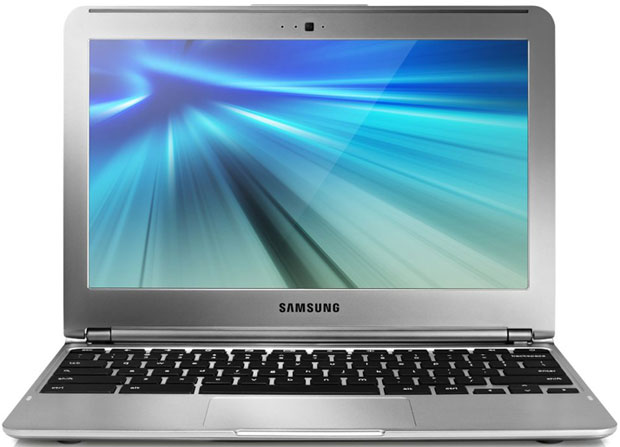
Google unveiled a new Samsung Chromebook on Thursday, available for pre-order at US$249. The new model is more streamlined and far cheaper than its predecessors.
Samsung Chromebook
Samsung Chromebook
It costs $200 less than the Samsung Chrome 550, which was released earlier this year, and $100 less than the Series 5 model, which debuted last year.
The sleek new form factor is compelling, said Craig Stice, senior principal analyst for compute platforms at IHS iSuppli.
"To have a successful product in mobile, it has to be very thin, very light," he told TechNewsWorld. "That is enough to draw attention from other products that are out there."
<script language='JavaScript1.1' src="http://ad.doubleclick.net/adj/N5506.126225.ECTNEWSNETWORK1/B7004710;abr=!ie;sz=160x600;ord=13508245199477?" type="text/javascript"><!--//<![CDATA[ //]]>//--></script> <noscript> <a href="http://ad.doubleclick.net/jump/N5506.126225.ECTNEWSNETWORK1/B7004710;abr=!ie4;abr=!ie5;sz=160x600;ord=13508245199477?"> <img src="http://ad.doubleclick.net/ad/N5506.126225.ECTNEWSNETWORK1/B7004710;abr=!ie4;abr=!ie5;sz=160x600;ord=13508245199477?" border="0" width="160" height="600" alt="Advertisement" /></a> </noscript>

Cloud Computer

This new machine does appear to be aimed at those wanting a sleek profile as it is just 0.8-inches thick, and weighs in at just 2.5 pounds. It features an 11.6-inch screen that supports a 1366x768 display. While not the highest-resolution screen out there, it reportedly does the job. It includes a webcam and microphone, enabling online video chatting.
It's light on connections with just one USB 3.0 port and one USB 2.0 port, plus an HDMI output and SIM card slot. However, it is primarily a cloud computing device, with Internet access via WiFi. A 3G model is available for preorder from Amazon for $330.
The Chromebook provides 16 GB of local SSD storage, as well as100 GB of cloud-based Google Drive storage, free for two years. The machine is thus clearly designed for life in the cloud.
"It is kind of in its own niche sort of thing," said Stice. "It is really just a Web device. It is an interesting type of product, a light computing device in a nice form factor."
Google did not respond to our request for further details.

Breaking Windows 8

The timing of the announcement is certainly interesting, and it isn't clear if the intent was to steal some thunder from Microsoft in advance of next week's long-anticipated release of Windows 8.
However, "Samsung and Google aren't stealing much thunder here," said Roger Kay, principal analyst of Endpoint Technologies Associates. "The purely Web device is still a thing of the future, and it hasn't made much headway in the marketplace so far. Its day will come when there's something approaching full connectivity."
The new device's reduced price could make that future closer.
"The Chromebooks have tended to lag far behind tablets in consumer interest and uptake [but] that may have been due, at least in part, to the $500-plus pricing of the original Chromebooks," said Charles King, principal analyst at Pund-IT.
"The lack of touch-enablement is another likely factor. The new Chromebook's $249 entry price -- plus two years/100GB of Google Drive storage -- should shatter the first barrier," he pointed out.
"More importantly, along with the recent addition of the Nexus 7, Google is the only vendor that has two distinct devices capable of leveraging its notable array of Web-centric applications and services," King told TechNewsWorld. "With the Surface, Microsoft seems to be aiming at delivering a best of both worlds -- touch- and keyboard-enabled -- solution that is clearly aimed at Apple's iPad."
The announcement's timing may mean nothing more than the onset of the annual shopping frenzy.
"We're entering the holiday season," said Stice. "So there are a host of platforms and products that are going to be launched. The fact that this was announced in advance of Windows may have been strategic on Google's part, but there are so many weeks in the fall."

Thursday, 29 March 2012

Windows 8 Release Candidate to surface by early June?

Could Microsoft unveil the Windows 8 Release Candidate as soon as early June? At least one report says yes.
Blogging site WinUnleaked.tk seems certain of that, spilling the beans over the weekend that "we know the Release Candidate of Windows 8 will be shared with the public between the end of May to the beginning of June." Apparently receiving the intel from an unnamed source, the site notes that the RC will sport at least a few changes from the current beta.
Modifications are in store for the Charms bar, the desktop version of Internet Explorer 10, and the language input menu. The current Customer Experience Improvement Program will also be disabled by default, says WinUnleaked.tk.
A Release Candidate follows a beta and is the last stage before a product's final version. Companies typically incorporate feedback about the beta into the RC, often resulting in a hefty number of changes. But the RC is supposed to be fairly nailed down, meaning few if any major changes before the final edition debuts.
Of course, without more to go on, this latest tidbit should be filed into the rumor drawer for now. But if true, the timing would somewhat mimic that of Windows 7.
The current version of Windows launched as a beta in January of 2009, followed by the Release Candidate in early May. The final version officially rolled out the following October, giving PC vendors just enough time to rev up Windows 7 systems for the holiday season.
The beta, or Consumer Preview, of Windows 8, came out on February 29. A recent report suggests that the final version of Windows 8 will launch this October.
Microsoft will reportedly hold an industry event in April at which it will share its Windows 8 release strategy and other details with industry partners. So we should know the actual timing for the Release Candidate sometime next month.
A spokeswoman for Microsoft told WEBMASTERS that the company has nothing to share at this time

The Denver Zoo's Poo-Powered Rickshaw Turns Animal Waste into Energy


Teddy Roosevelt famously said “Do what you can, with what you have, where you are.” The folks at the Denver Zoo must have thought he was talking crap. The zoo happens to have a lot of animal dung on hand where it is, and via its own patent-pending gasification tech it is doing what it can, introducing a poo-powered rickshaw that turns animal waste and human trash into mobility.
The rickshaw was purchased from Thailand and modified to run on gasified pellets created by the zoo’s own technology. Those pellets, composed of animal waste and garbage generated by human visitors and zoo staff, aren’t just powering the rickshaw, but will be used to generate power at the zoo’s upcoming 10-acre elephant exhibit. Eventually, the zoo thinks it will be able to turn 90 percent of its waste into energy, making use not only of the copious amounts of animal poo it has on hand but also eliminating some 1.5 million pounds of annual garbage waste that previously went into landfills.
The gasification technology was designed by three full-time zoo employees working with a little help here and there from the National Renewable Energy Lab in nearby Boulder, as well as a few other companies and agencies. So it’s a home-grown, DIY system that could presumably be exported to other zoos and anywhere else animal waste is in abundance and energy is needed. This particular rickshaw has already been exported, landing at the Association of Zoos and Aquariums in Palm Desert, Calif., this week.

Web hosting